Ownership costs·8 min read
Service Charges in Dubai 2026: What You Will Actually Pay
Service charges in Dubai vary more than most buyers expect. A real breakdown by area and tower type — and what to check before you buy.
Access Group Realty·June 25, 2026
Service charges are one of the most underestimated costs in Dubai property ownership — and one of the most variable. Two apartments in the same community, 50 meters apart, can carry charges that differ by AED 10,000 or more per year. Understanding how these charges work before you buy can meaningfully change your net return calculation.
What Are Service Charges?
In Dubai, service charges (also called community or maintenance fees) are annual payments owners make to fund the upkeep of shared areas — lobbies, gyms, pools, security, landscaping, and building maintenance.
Since Law No. 6 of 2019 on Jointly Owned Property, the building's management company prepares the annual budget and files it with the Dubai Land Department for approval through Mollak, the system RERA runs for jointly owned property. Owners committees represent owners and can push back on the budget, but they do not set the charge themselves. Approved charges are published, so you can look yours up rather than take anyone's word for it.
In practice, charges vary enormously — from under AED 8 per square foot in well-managed older buildings to over AED 30 per square foot in luxury high-rises with extensive amenities.
How Charges Are Calculated
Service charges are expressed as an annual rate per square foot of the property's registered area. If your apartment is 800 square feet and the building charges AED 15 per square foot, you pay AED 12,000 per year.
One important nuance: the registered area in Dubai often includes a proportion of common areas in addition to your apartment's internal square footage. The figure on your title deed may be 10% to 20% larger than the space inside your walls, and this inflated registered area applies to the service charge calculation.
What Drives Charges Up
Amenities — larger gyms, multiple pools, concierge, and valet parking all cost more to operate, and every amenity's maintenance cost is divided among owners.
Building age and condition — older buildings tend to have higher maintenance costs as equipment ages. A 10-year-old building in Dubai Marina often carries higher charges than a brand-new building in the same area.
Poor initial management — some buildings were underfunded by developers early on, and the accumulated deferred maintenance landed on whoever manages them now, producing over-budget years and special assessments.
Reserve fund contributions — RERA requires buildings to maintain a reserve fund for major future repairs (elevators, facade, plant rooms). A poorly funded reserve will eventually require a large special contribution from owners.
Area and Tower Type Breakdown
The ranges below are indicative, for orienting yourself before you shortlist. They are not a substitute for the approved figure: charges are set per building, they change annually, and the Service Charge Index will tell you the exact number for the tower you are actually considering.
Luxury high-rises (Downtown, Palm Jumeirah, DIFC) — broadly AED 20 to 35 per square foot, with the most amenity-heavy landmark towers running higher still. For a 1,000 sqft apartment that is roughly AED 20,000 to 35,000 a year.
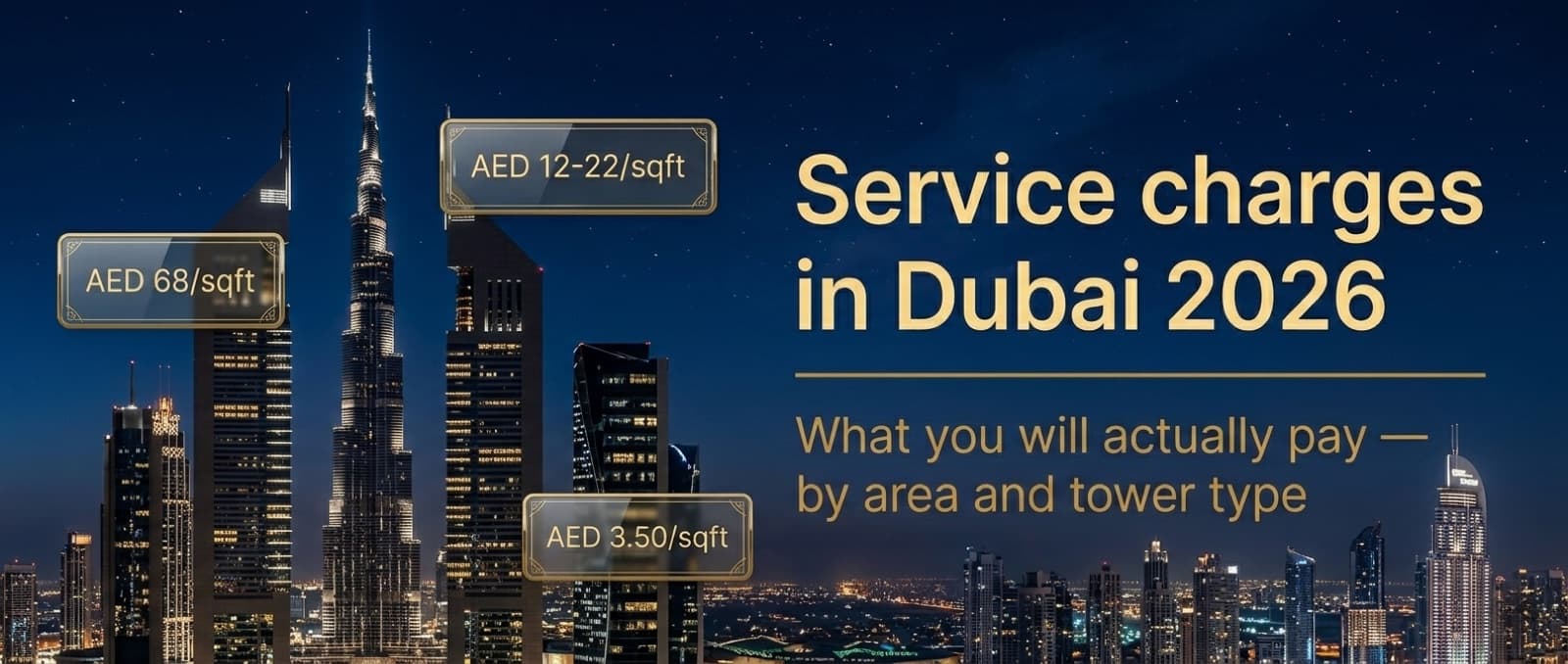
Mid-market towers (Dubai Marina, JLT, Business Bay) — a wide band, roughly AED 12 to 22 per square foot. Newer, well-managed towers sit at the bottom of it; older towers carrying deferred maintenance sit at the top.
Affordable communities (JVC, International City, Discovery Gardens) — broadly AED 10 to 18. Because prices and rents are lower here, a AED 5/sqft difference has a bigger proportional effect on your return than the same gap in a luxury building.
Villa communities (Dubai Hills, Arabian Ranches, The Springs) — charged on built-up area at rates that are low by Dubai standards, typically low single digits per square foot. Villas are large, though, so a 3,500 sqft home still lands in the thousands per year.
Serviced and hotel-branded residences — typically the highest charges of any property type, reflecting a hotel-like cost structure. The trade-off is access to the operator's rental programme.
How to Check Before You Buy
Look the charge up yourself — the Dubai Land Department publishes approved service charges by project and year in its Service Charge Index, free and open to anyone, through the Mollak portal or the Dubai REST app. That is the approved figure rather than an estimate from a listing, and it takes a minute.
Check the reserve fund balance — a low reserve fund is a warning sign that a special assessment could be coming.
Look at the last 3 years of charges — a 5% to 10% annual increase is normal for inflation; 20% to 30% increases suggest a maintenance backlog being worked through.
Factor it into your yield calculation properly — to get net yield, subtract annual service charges, the agency management fee (typically 5% to 10% of annual rent), and a vacancy assumption from gross rental income. The gap between gross and net yield in Dubai can easily be 1.5% to 2.5%.
A Simple Reality Check
If you are comparing two apartments — one at AED 900,000 with a 7% gross yield and AED 16/sqft charges, and another at AED 1,100,000 with a 6% gross yield and AED 10/sqft charges — the net yields may be much closer than the headline numbers suggest. Run both calculations with service charges included before deciding.
Service charges are not negotiable once you own a unit, and they can change each year. Buying in a well-managed building with transparent financials is as important as the area and the price.
Sources and verification
- Claims last verified:
Service charges are set per building and reapproved every year, so any range here is orientation, not a quote. Look up the approved figure for the specific project in the Dubai Land Department's Service Charge Index before you rely on a number.
| Claim | Official source | Last verified |
|---|---|---|
| Service charges for jointly owned property are governed by Law No. 6 of 2019, administered through the Mollak system. | Dubai Land Department — Mollak | |
| The annual service charge budget is submitted by the management company and approved by the Dubai Land Department, not set by owners themselves. | Dubai Land Department — Approval of service and usage charges | |
| Approved service charges are published per project and year and can be looked up free of charge by anyone. | Dubai Land Department — Service Charge Index |
Want this applied to your budget?
We'll turn it into a focused shortlist of live Dubai off-plan projects.